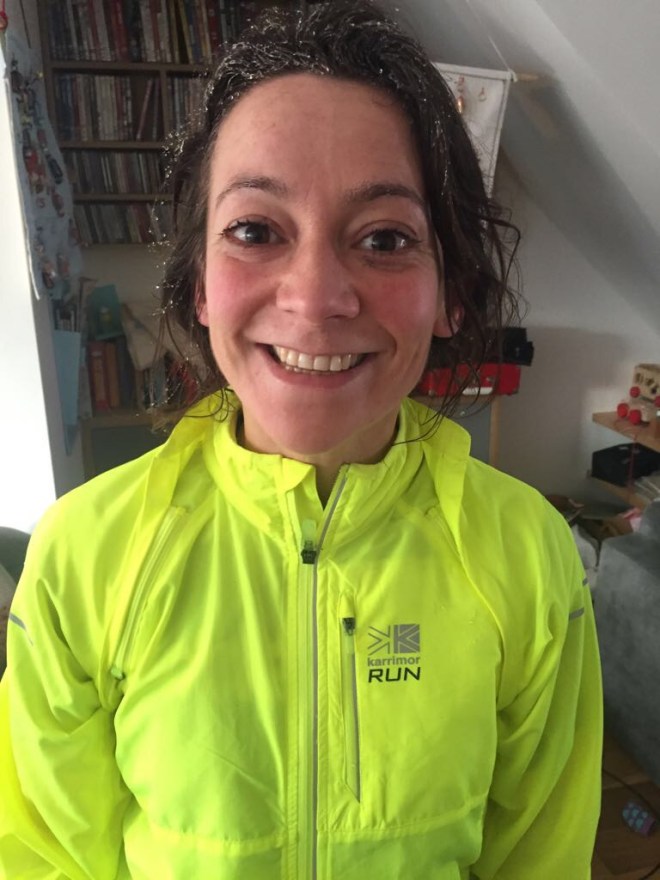
 This is the first time in my life I have gone running in December. It’s been cold!!!! That’s ice in my hair, the ice on my eyelashes had melted by the time we got the phone out. It’s been good!! This month I have run alongside robins, into sunsets, with friends, up hills, down hills, and last week I did 10 miles and felt great. And I did my first ever Parkrun which I loved – New Year’s Day double in Hove, where the waves came over the side of Hove Prom and soaked my shoes within 5 minutes of starting. I’m enjoying myself! So wishing you all a Happy New Year, here is January’s blog. It’s a bit of a long one I’m afraid, but please stick with it, it’s one of the most important I think.
I had a bit of a wobble last month about the blog. A couple of things happened as a result of it that made me question it all a bit. Firstly, am I the right person to be doing this? Should I be talking about Eva in the blog in such a public way? A couple of notes on this: I am really trying to make this blog about me and my experience of Eva’s addiction. I am really trying not to assume anything about the reasons that she struggled so much with mental health, or talk about the bad things that happened because of her drinking. She is not here to correct me or guide me through that. And it misses the point. It is not about any of that. So I asked myself, “What is it about?” Is it for me? For catharsis? Maybe. Is it to remind people about her? I am constantly afraid that she’ll be forgotten. I know I love to talk about her, I love the fact I am getting to talk about her because I am so proud of her and I miss her and I love remembering her. But I know, in my heart of hearts, that this isn’t the main reason for it either. What I really want you to do in reading this blog is, forgetting the addiction, to look at her, look at us as a family, and see yourselves and your loved ones. I want you to see her not as “the other”, the “alcoholic”, but as one of “us”. We are all human and we all have vulnerabilites and we all have strengths and weaknesses and we all get sick from time to time. Some of us are lucky in that most of the time it is something acute and mild that we recover from and don’t have to face again, and some of us are less lucky. I know that Eva is a statistic somewhere, that she is a “person with an addiction” but she is you and she is me. She was unlucky, she got dealt a really bad hand.
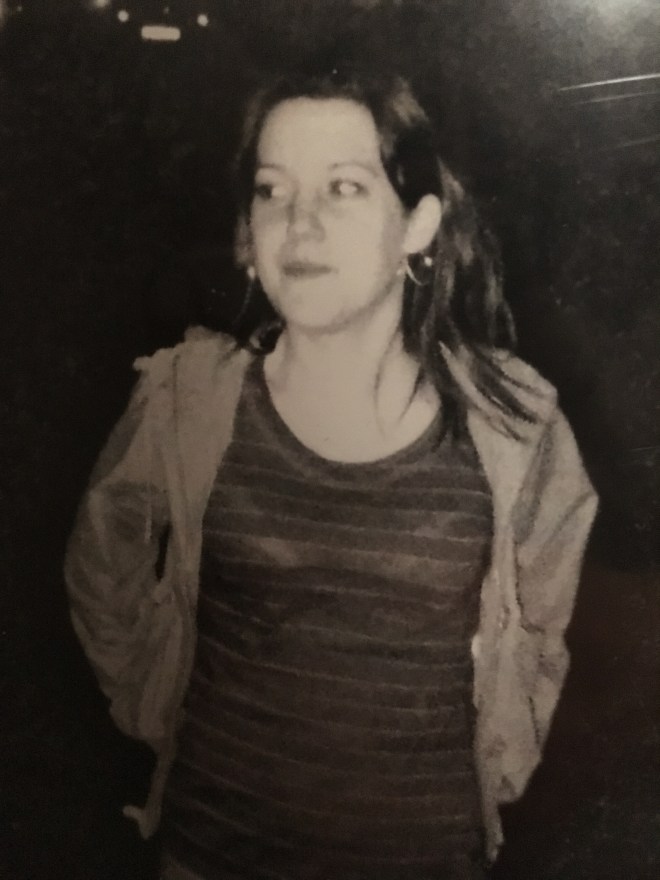
So, that’s the reason for writing. It’s the STIGMA. I’m sure that’s what I’m trying to change. Because if I hadn’t shown you her face or related her story or told you about her personality traits, she would have remained a statistic. You would have formed an opinion of her, as even I did when she was alive, as we all do as humans. Evolutionary psychology means it is innate, and media and fear facilitate it.
Stigma is defined by the Oxford English Dictionary as, “a mark of disgrace or infamy; a sign of severe censure or condemnation, regarded as impressed on a person or thing; a ‘brand'”. When I started writing these blogs, I honestly thought our story, given Eva’s age I suppose, might catch attention. I was hugely saddened that I didn’t have to look hard to find numerous stories written by people relating to the deaths of other young women with addictions. One mother tells the story of her daughter, Sammi, who took her own life. She was too ashamed, too ashamed of herself, too ashamed of her alcohol addiction to ask for help. Eva, too, had a couple of suicide attempts. That is the strength of stigma. It shames the vulnerable people who need us to sit down next to them and say, “I’m here when you need me, it’s ok, I’m listening and I love you.” Stigma marginalises people, it makes them “the other”. It stops people admitting to themselves that their drinking has become a problem, it stops people saying the words “I need help” and it stops people accessing support. We know that fewer people die who access support, so, I guess I can say that stigma kills. Sounds strong though doesn’t it. When life has the potential to be so wonderful, and we only get one shot at it, it seems a silly reason to die, people’s opinions.
Adfam, a society set up for improving support for families affected by drugs and alcohol, carried out some qualitative research about the effect of stigma on families of individuals with drug and alcohol addiction. One individual told of how, when he applied for a free bus pass he was told that due to his substance misuse issues, he would not be entitled to one. I was horrified to read this. I think of how vulnerable Eva was when she was starting her life again sober after rehab, and how much this would have affected her, not just the difficulties with bus travel but the treatment, the disapproval, the stigma, the judgement. How are people meant to recover when policies and stigma like this continues? When they are low and need support, and above all need to be treated as humans, they are marginalised.
The statistics from the report make me incredibly sad. They are mostly concerned with drug addiction but that’s irrelevant to me, it is about substance addiction.
“93% of people think that those with a mental illness deserve the best possible care.” Not dreadful but could be improved.
“68% think the same about people with a drug dependence.” Really sad. So obviously it is just not seen through the same eyes as mental health, does this mean that 32% believe they deserve substandard care? Or no care?
“58% of people think one of the main causes of drug dependence is lack of self discipline and willpower.” How misinformed. Could we counter that with the fact that 81% of women with addiction issues have been victims of physical and sexual abuse in younger years. That’s something that luckily many of us will never have experienced during our childhoods. So who are we to stand and look down our noses and condemn? We have no idea about that individual’s story, and a lot of the time it is because we don’t ask and we don’t care.
“23% of people believe that most people would not become dependent on drugs if they had good parents.” I need you to know how wonderful my parents are. That they adore my brother and I, do anything for us, tell me they love me every time we say goodbye on the phone, nurtured us through childhood, encourage us, are interested in the things we’re interested in, care about the things we care about. And when Eva was unwell, they were rocks. They supported her incredibly and kept the peace when I was making a mess of my relationship with her. Now, along with my husband and brother, they are truly my best friends. And I know I can say the same of my brother too. They are completely non-judgemental, which I adore about them, and they see humour in almost everything. It is telling that many of Eva’s friends keep in touch with them. They are gentle people, intelligent and interested. They are just the best people I know. Eva was supported strongly throughout her illness by them both, they did not cause it.
These statistics are from 2012. I would love to think that these opinions have changed somewhat, especially following the mental health marathon last year and the continued push in some areas of the media for more openness surrounding mental health issues. But I cannot help but feel that alcohol and drugs are continued to be seen as different. That the “moral failure” element prevails.
A research article published in 2010, “The Stigma of Alcohol Dependence Compared With Other Mental Disorders: A Review Of Population Studies” does not shy away from the realities of alcohol misuse. In this article they state that “some negative stereotypes like being dangerous or unpredictable, however, cannot simply be rejected as wrong.” But then continues, “We would argue, that in the case of alcoholism, even if they apply to some…..they hurt many more, particularly those struggling to recover from their illness. Affected individuals have a right to be judged by their personal behaviour, not by the stereotypes attached to a diagnostic label.”
Portugal does things differently. They have decriminalised all drugs. As a result, any kind of drug or alcohol induced “incident” will be treated with healthcare rather than criminalisation. The individual will be put through an addiction treatment programme, and then, most importantly, money that would ordinarily have been used to put them in prison, is used to find them a job, to reintegrate them, to give them a reason to get up in the morning, to reconnect them to society. Outcomes are great. This model has continued for over a decade now and regardless of changes of government has not been changed, because it works.
So how do we try and change the stigma? And what are we trying to achieve?
We talk about it. That is what my reasoning is behind this blog. I know it is. To make you maybe think twice. We talk about it, we talk about it as a health issue, we present more positive pictures in the media, we promote social inclusion like Portugal does, we look at people as people, we BELIEVE IN PEOPLE, we see people as humans that are hurting and we tell them we care. And what will it achieve? More people accessing support, less marginalisation in society, fewer lives lost. It seems such an achievable thing. I thank each and every one of you for reading these blogs, and I hope it has touched you or made you think in some way so far. The more people I reach the more people I have a hope are listening, so please, share with your friends. I have no doubt that this blog is not going to change the world, but it is changing me.
When she died, I drank. I drank to forget, to block out reality, to escape, I drank for all the same reasons she drank. The irony isn’t lost on me, especially given the strength with which I condemned her. I judged her. As her sister, I judged her. Just when she needed me. I thought she was “better” than alcohol addiction. That’s dreadful isn’t it, that is in complete contrast to everything I have talked about and learned about for this blog. I saw it as self indulgence, her fault, and that people with addiction were “below me”, “below us”, they were “the other”. Eva suffered with alcohol addiction, it could just as easily have been me, and how I would have crumbled and crawled under a rock and drank myself into a hole if people treated me the way she was treated by me, and by others. It just so turned out that out of the two of us, Eva and I, I was the lucky one. How unfair and cruel life can be sometimes.
Thank you so much for reading, and for all those who have donated, thank you again. I appreciate every single penny. If you haven’t donated already and you can spare any money at all for the cause, the link to my Virgin money giving page is below.
https://uk.virginmoneygiving.com/fundraiser-portal/fundraiserPage?pageId=854688
And if you need support:
https://www.alcoholics-anonymous.org.uk
And for family and friends:
 My London Marathon 2018